


Introduction
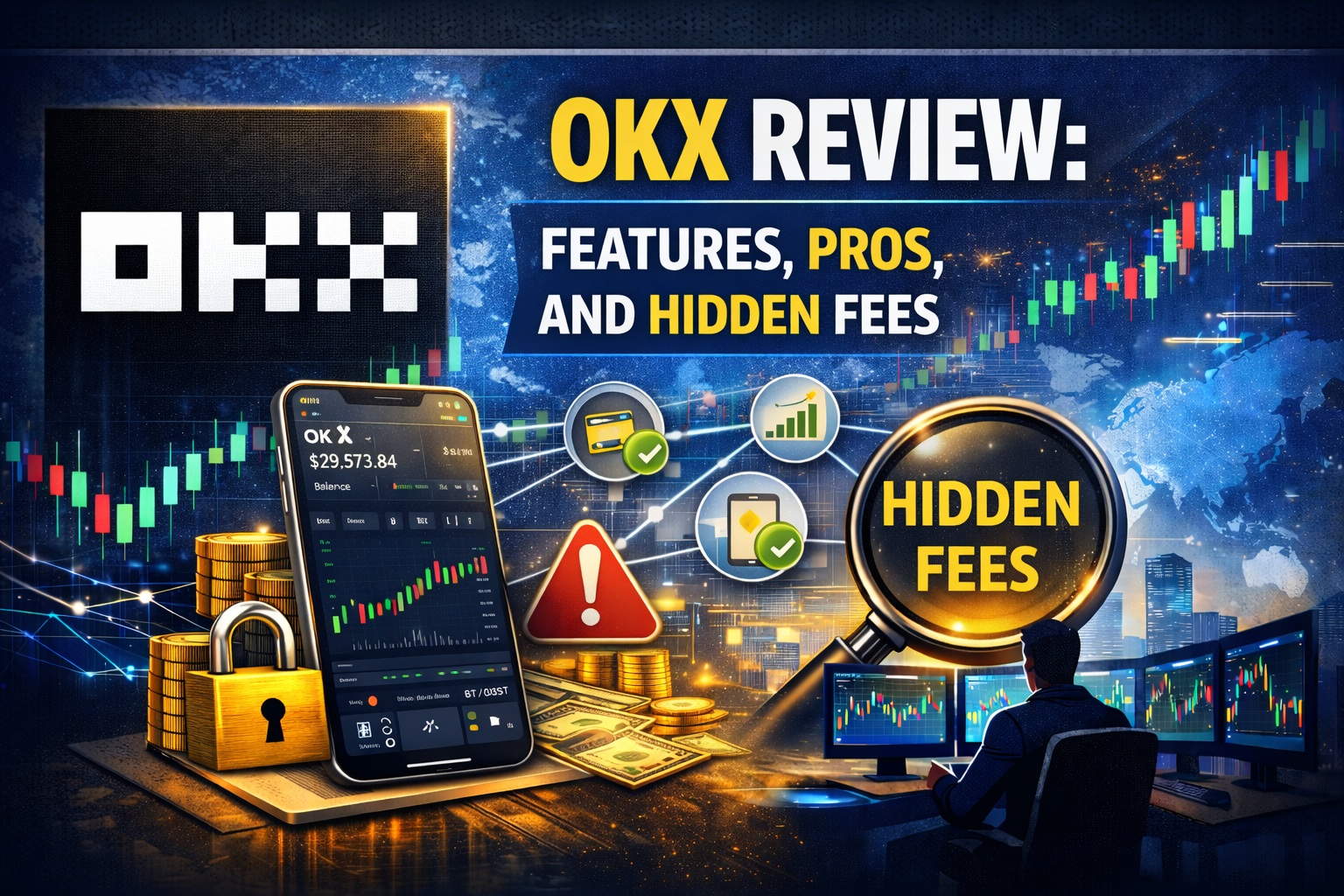
Is OKX a feature-rich and cost-transparent crypto exchange? Yes, OKX is one of the world’s leading cryptocurrency platforms offering extensive trading tools, derivatives markets, and DeFi services—but its fee structure includes nuances that traders need to understand to avoid unexpected costs.
OKX appeals to active traders seeking advanced features like futures, options, and leverage trading alongside competitive maker/taker fees. However, costs like funding rates, spreads, and network withdrawal fees can add up, particularly for leveraged positions and frequent withdrawals.
This review examines OKX’s core features, transparent advantages, and the hidden fees many users overlook—helping you decide if this platform aligns with your trading goals and experience level.
What Is OKX?
OKX is a global cryptocurrency exchange founded in 2017 (originally as OKEx), headquartered in Seychelles with operations spanning over 100 countries. The platform serves millions of users worldwide, offering comprehensive crypto services beyond basic spot trading.
What OKX offers:
- Spot trading: 300+ cryptocurrencies including Bitcoin, Ethereum, and altcoins
- Derivatives: Futures, perpetual swaps, and options contracts
- DeFi hub: Yield farming, staking, and liquidity mining
- Web3 wallet: Non-custodial wallet supporting multiple blockchains
- NFT marketplace: Trading and minting digital collectibles
Platform availability:
- Web-based trading terminal
- Desktop applications (Windows, macOS)
- Mobile apps (iOS, Android) with full feature parity
OKX positions itself as an all-in-one ecosystem for experienced traders who want access to traditional exchange services alongside decentralized finance opportunities.
Key Features of OKX
Trading Platforms
Spot trading interface:
- Professional-grade order book with depth charts
- Multiple order types: market, limit, stop-limit, iceberg, TWAP
- TradingView integration for technical analysis
- One-click trading mode for quick executions
Advanced charting tools:
- 100+ technical indicators
- Drawing tools and pattern recognition
- Custom timeframes and multi-chart layouts
- Real-time market data feeds
Mobile vs desktop experience: The mobile app replicates most desktop functionality, including advanced orders and portfolio tracking. Desktop offers larger screen real estate for multi-monitor setups and slightly faster execution speeds.
Derivatives & Leverage
Futures contracts:
- Quarterly and bi-quarterly delivery futures
- Up to 125x leverage on select pairs
- Cross-margin and isolated margin modes
Perpetual swaps:
- No expiration date contracts
- Funding rate mechanism every 8 hours
- USDT-margined and coin-margined options
Options trading:
- European-style options on BTC and ETH
- Call and put contracts
- Implied volatility indicators
Risk profile: Leverage amplifies both gains and losses. OKX provides risk calculators and liquidation price warnings, but inexperienced traders can face rapid account depletion during volatile market conditions.
Earn & Savings
Staking products:
- Fixed-term staking (30/60/90 days) with guaranteed APY
- Flexible staking with daily interest and no lock-up
- 50+ supported assets including ETH, SOL, DOT
Yield products:
- Dual investment (structured products betting on price direction)
- Liquidity mining pools with rewards in platform tokens
- Simple Earn for passive income on idle holdings
APYs vary by asset and market conditions, ranging from 1-15% for major cryptocurrencies to higher rates for smaller-cap tokens with increased risk.
Wallet, Security & Ecosystem
Built-in wallet features:
- Self-custodial Web3 wallet integrated into the platform
- Multi-chain support (Ethereum, BSC, Polygon, Arbitrum, 40+ networks)
- DApp browser for accessing decentralized applications
Security measures:
- Cold wallet storage for majority of user funds
- Two-factor authentication (2FA) mandatory for withdrawals
- Anti-phishing codes and withdrawal whitelist options
- Proof of Reserves published quarterly
Additional ecosystem:
- OKX NFT marketplace with cross-chain minting
- OKX Ventures for blockchain project investments
- Educational resources (OKX Learn) and trading competitions
OKX Fees — Transparent & Hidden
Standard Fees
Maker/taker structure:
| Trading Volume (30-day) | Maker Fee | Taker Fee |
|---|---|---|
| < $1M | 0.08% | 0.10% |
| $1M – $10M | 0.07% | 0.09% |
| $10M – $50M | 0.06% | 0.08% |
| $50M+ | 0.05% | 0.07% |
Fees decrease with higher 30-day trading volume and increase with OKB (platform token) holdings, offering up to 25% discount.
Volume tier calculations:
- Resets monthly based on trailing 30-day volume
- Includes spot and derivatives trading
- VIP tiers (Level 1-9) unlock at $10M+ monthly volume
Leveraged Products Fees
Funding rates (perpetuals):
- Charged every 8 hours between long and short traders
- Typical range: -0.05% to +0.05% per funding period
- During extreme market conditions, can exceed ±0.5%
Example: A $10,000 BTC perpetual position with 0.01% funding rate = $1 fee every 8 hours ($3/day, $90/month if held continuously).
Overnight costs: Futures contracts don’t have funding rates but include implicit costs through basis spreads (price difference between futures and spot).
Liquidation fees:
- 0.05% of position value for partial liquidations
- Reduces available margin, accelerating full liquidation risk
Deposit & Withdrawal Fees
Crypto transfers:
- Deposits: Free (you pay network gas fees to send)
- Withdrawals: Dynamic fees based on blockchain congestion
Sample withdrawal costs:
- Bitcoin: 0.0004 BTC (~$40 at $100k BTC)
- Ethereum: 0.005 ETH (~$20 at $4k ETH)
- USDT (TRC-20): 1 USDT
- USDT (ERC-20): Variable, typically $5-25
Fiat options: Limited fiat support varies by region. Credit/debit card purchases include:
- Processing fee: 3-5%
- Third-party payment processor markup
- Not available in all jurisdictions
Hidden Cost Signals
Spreads on market orders: The bid-ask spread (difference between buy and sell prices) acts as an invisible fee. On less liquid trading pairs, spreads can reach 0.5-2%, effectively doubling your costs.
Funding rate volatility: Perpetual swap funding rates change based on market sentiment. During bull markets, longs often pay 0.1%+ per 8-hour period, costing significantly more than the base trading fee over time.
Conversion fees: OKX’s “Convert” feature for instant swaps charges embedded spreads rather than transparent fees—typically 0.3-1% above the market rate.
Inactivity and maintenance: Currently, OKX does not charge inactivity fees. However, small dust balances (< $10) may have limited withdrawal options without converting first.
Slippage on large orders: Market orders that exceed available liquidity at the best price level will execute at worse prices. This implicit cost increases with order size on lower-volume pairs.
Pros of OKX
Extensive asset selection: 300+ cryptocurrencies with continuous listings of emerging tokens and DeFi projects.
Advanced trading tools: Professional-grade charting, order types, and API access rival institutional platforms.
Competitive fee structure: High-volume traders benefit from tier discounts, with maker fees as low as 0.05%.
Multiple market access: Seamlessly trade spot, futures, options, and perpetual swaps from one account.
Robust mobile experience: Full-featured iOS/Android apps enable trading and portfolio management on the go.
Staking and yield opportunities: Passive income options across 50+ assets with flexible and fixed-term products.
Integrated Web3 wallet: Self-custody solution connects directly to DeFi protocols without transferring funds off-platform.
Strong liquidity: Top-tier order book depth on major pairs ensures minimal slippage for large trades.
Educational resources: Comprehensive tutorials, market analysis, and trading guides support skill development.
Cons & Things to Watch
Steep learning curve: The platform’s complexity overwhelms beginners unfamiliar with derivatives and advanced order types.
Funding rate costs add up: Long-term leveraged positions incur daily funding fees that can exceed the initial trading fee savings.
Leverage risk exposure: 125x leverage enables rapid gains but also catastrophic losses—new traders frequently get liquidated.
Regional restrictions: Regulatory compliance limits services in the United States, Canada, and several other jurisdictions.
Customer support delays: During high market volatility, response times for tickets can extend to 24-48 hours.
Withdrawal processing times: Manual review for large withdrawals (>$50k) can delay access to funds by several hours.
Hidden spreads on conversions: The instant swap feature lacks transparency compared to limit order trading.
Complex fee schedule: Understanding the interaction between trading fees, funding rates, and withdrawal costs requires research.
Who OKX Is Best For
Ideal user profiles:
Active traders: Those executing multiple trades daily benefit from volume-based fee discounts and advanced order types.
Experienced crypto investors: Users comfortable with derivatives, leverage, and risk management can exploit the full feature set.
Multi-market participants: Traders wanting exposure to spot, futures, and options without managing multiple exchange accounts.
DeFi enthusiasts: The integrated Web3 wallet and DApp browser streamline interaction with decentralized protocols.
International users: Non-US residents in supported countries access the complete platform without restrictions.
Not recommended for:
Complete beginners: New crypto users should start with simpler platforms like Coinbase or Kraken before tackling OKX’s complexity.
Buy-and-hold investors: Those purchasing crypto for long-term storage may prefer exchanges with simpler interfaces and lower withdrawal minimums.
US-based traders: Regulatory limitations prevent US residents from accessing most OKX services.
Risk-averse individuals: Leverage and derivatives trading can result in losses exceeding initial deposits.
FAQ
What features make OKX stand out?
OKX distinguishes itself through comprehensive derivatives markets (futures, perpetual swaps, options), an integrated Web3 self-custody wallet, advanced trading tools with TradingView integration, and staking yields across 50+ cryptocurrencies—all accessible from web, desktop, and mobile platforms.
How much are OKX fees?
Standard spot trading fees start at 0.08% maker and 0.10% taker, decreasing to 0.05%/0.07% for users trading over $50M monthly. Withdrawal fees vary by cryptocurrency (e.g., 0.0004 BTC, 0.005 ETH). Leveraged products include funding rates typically between -0.05% to +0.05% every 8 hours.
Are there any hidden fees on OKX?
Yes—bid-ask spreads on market orders, perpetual swap funding rates that compound over time, embedded conversion fees (0.3-1%) in the instant swap feature, and network withdrawal costs that vary with blockchain congestion. These indirect costs can exceed base trading fees for certain strategies.
Is OKX safe to use?
OKX implements industry-standard security including cold wallet storage for most funds, mandatory 2FA for withdrawals, quarterly Proof of Reserves audits, and anti-phishing protections. However, exchange-based custody always carries counterparty risk—users should enable all security features and consider transferring long-term holdings to personal wallets.
Can beginners use OKX?
While OKX offers basic spot trading, the platform’s emphasis on derivatives, leverage, and advanced features creates a challenging environment for newcomers. Beginners should thoroughly understand cryptocurrency basics, order types, and risk management before using OKX—or start with more beginner-friendly exchanges first.
Conclusion
OKX delivers a feature-rich trading ecosystem for experienced cryptocurrency users seeking comprehensive market access, advanced tools, and competitive fees at scale. The platform excels in derivatives offerings, staking opportunities, and Web3 integration—creating an all-in-one hub for active traders.
Key advantages include:
- Extensive cryptocurrency selection (300+ assets)
- Professional-grade charting and order execution
- Volume-based fee discounts (as low as 0.05% maker)
- Robust mobile and desktop applications
Cost transparency requires understanding:
- Standard maker/taker fees are competitive but represent only part of total costs
- Funding rates on perpetual positions accumulate daily
- Withdrawal fees, spreads, and conversion costs add hidden expenses
- Leverage amplifies both gains and losses rapidly
Final verdict: OKX is best suited for intermediate to advanced traders who understand derivatives, can manage risk across leveraged positions, and execute sufficient volume to benefit from fee discounts. The platform’s complexity and hidden costs make it less appropriate for beginners or casual investors seeking straightforward buy-and-hold experiences.
If you’re comfortable navigating advanced trading interfaces and want access to multiple markets from one platform, OKX’s feature set justifies the learning curve. However, new crypto users should build foundational knowledge on simpler exchanges before tackling OKX’s comprehensive but complex ecosystem.
Simply want to say your article is as astonishing. The clarity
in your post is just excellent and i could assume you are an expert on this subject.
Fine with your permission allow me to grab your feed to keep up to date
with forthcoming post. Thanks a million and please keep up the
rewarding work.