


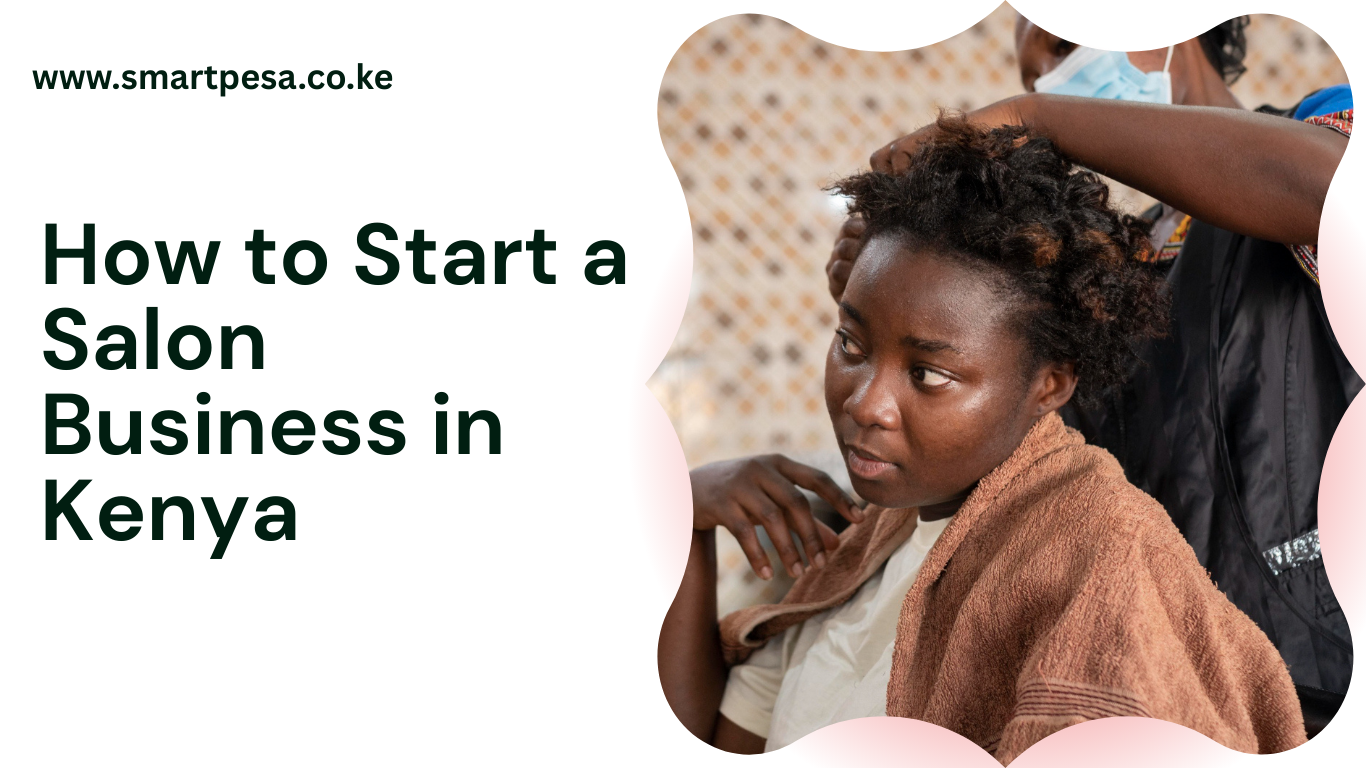
Starting a salon business in Kenya remains one of the most profitable ventures in the personal care business sector in 2026.
With Kenyans spending an estimated KES 50-80 billion annually on hair care, beauty treatments, and grooming services, the beauty salon business offers exceptional returns for entrepreneurs who understand the market.

Whether you’re targeting middle-class women in Nairobi estates, university students in Eldoret, or professionals in Mombasa, well-executed hair salon ideas Kenya can generate consistent income with manageable salon startup cost Kenya.
Unlike product-based businesses, salons create recurring revenue—customers return every 2-4 weeks, building predictable cash flow and strong client relationships.

This comprehensive guide provides everything you need to launch your salon successfully, from equipment selection to staff management, complete with realistic costs in KES and proven strategies for the Kenyan beauty market.
Overview of the Business Opportunity in Kenya
A salon business provides hair care, beauty treatments, and grooming services from a physical location. Services typically include hairstyling (braiding, weaving, perming, relaxing), haircuts, hair treatments, makeup application, manicures, pedicures, and sometimes facials or massage services. Unlike mobile hairdressers who visit homes, salons offer a dedicated professional space with specialized equipment and multiple service providers.
In 2026, demand for salon services across Kenya continues growing driven by several factors: expanding urban middle class with disposable income, social media influence promoting beauty standards, corporate environments requiring professional grooming, and cultural celebrations (weddings, graduations, religious events) driving special occasion demand. Women aged 18-45 form the primary customer base, though men’s grooming salons (barbershops with added services) are rapidly growing segments.
The business model creates natural customer retention—hair maintenance requires regular visits, creating predictable appointment schedules and stable revenue. Successful salons become community hubs where clients build relationships with stylists, ensuring loyalty even when competitors open nearby.

Why This Business is Profitable in Kenya
The beauty salon business offers several profit advantages making it one of the most attractive personal care business opportunities in Kenya for 2026:
High-Margin Service Business Unlike retail, salons sell expertise and time rather than physical products. Labor and skill command 60-75% gross margins. A KES 1,500 braiding service costs KES 300-400 in materials (extensions, gel), generating KES 1,100-1,200 profit per client. Monthly revenue of KES 400,000 can yield KES 240,000-280,000 gross profit.
Recurring Revenue Model Hair maintenance creates predictable cycles. Braids last 6-8 weeks, relaxers need retouching every 8-10 weeks, weaves require 4-6 week maintenance. This built-in repeat business means satisfied clients return indefinitely, reducing customer acquisition costs significantly.
Multiple Revenue Streams Beyond core hairstyling, salons generate income from product retail (shampoos, conditioners, hair oils sold at 40-60% markup), premium add-ons (deep conditioning KES 500, scalp treatments KES 800), special occasion packages (bridal makeup KES 8,000-15,000), and membership programs offering discounted regular services.

Target Customers Primary customers include working professionals (ages 25-45) seeking convenient, quality grooming; college and university students preferring trendy, affordable styles; corporate women maintaining professional appearances; brides and wedding parties for special occasions; and increasingly, men seeking beard grooming, haircuts, and facials.
Urban vs Rural Performance Urban salons benefit from higher population density, greater disposable income, fashion-conscious clientele willing to pay premium prices, and demand for diverse services including makeup, nails, and advanced treatments. Expect urban salons (Nairobi, Mombasa, Kisumu) to charge KES 1,500-4,000 for standard services.
Rural salons serve price-sensitive markets but enjoy lower rent (KES 8,000-15,000 vs KES 25,000-60,000 urban), reduced competition, and community loyalty. Services price at KES 800-2,000 but operating costs are significantly lower, maintaining healthy margins.
Step-by-Step Guide on How to Start
Step 1 – Market Research and Location Selection
Conduct Market Research Visit 5-10 existing salons in your target area during different times (weekday mornings, Saturday afternoons). Note their service menus and pricing (braids, weaves, relaxers, cuts), client volume and demographics, waiting times, staff-to-client ratios, and overall ambiance and cleanliness standards.
Interview potential clients informally. Ask women about their current salon experience—what they spend monthly, what frustrates them (long waits, poor quality, unfriendly staff), preferred services, and willingness to try new salons offering better value or experience.
Identify market gaps. Perhaps local salons lack modern styling techniques (ombre coloring, silk press), close too early for working women, don’t offer online booking, or ignore male grooming. These gaps become your competitive positioning.
Choose the Right Location Location determines 70% of salon success. Prioritize these factors:
- High female foot traffic: Near residential estates, shopping centers, or office buildings where your target market lives or works
- Visibility and accessibility: Ground floor with clear signage, easy walking access, and ideally parking or matatu drop-off points
- Competitive density: Near (but not next to) established salons—beauty service clusters attract customers comparison-shopping
- Security and ambiance: Safe, well-lit neighborhoods where clients feel comfortable visiting evenings or weekends
- Space requirements: Minimum 400-600 square feet for 3-4 styling stations, washing area, waiting space, and storage
Ideal locations include estate shopping complexes (South B, Rongai, Syokimau), CBD office building ground floors, university town commercial strips (Egerton, Kenyatta University), or busy market perimeters. Avoid residential areas without commercial traffic.
Read also; How to Start a Cereal Shop in Kenya
Expect monthly rent: KES 15,000-30,000 (rural/small town), KES 25,000-50,000 (estate locations), KES 40,000-80,000 (prime urban commercial areas).
Step 2 – Licenses, Permits, and Legal Requirements in Kenya
Operating legally builds customer trust and prevents costly penalties. Required documentation:
Business Registration Register your business name with the Registrar of Companies (KES 1,950 online for sole proprietorship, KES 10,000-12,000 for limited company). Display the certificate prominently in your salon.
County Trade License Apply at county government offices. Annual costs range KES 5,000-20,000 depending on county, salon size, and location classification. This is mandatory before opening.
Public Health License Salons are classified as public health facilities. Obtain certification from the County Public Health Department showing compliance with hygiene standards. Cost: KES 3,000-8,000 annually. Inspectors check sterilization procedures, water supply, waste disposal, and ventilation.
KRA PIN and VAT Registration Register for KRA PIN (free). If annual turnover exceeds KES 5 million, register for VAT. Maintain proper books—income records, expense receipts, staff payroll.
NHIF and NSSF Registration (If Hiring Staff) Register employees with NHIF and NSSF, deducting and remitting contributions monthly. Failure risks penalties and labor disputes.
Fire Safety Certificate Required for salons in commercial buildings. Costs KES 5,000-10,000. Install fire extinguishers (KES 3,000-5,000 each) near electrical equipment and chemical storage areas.
Signage Permit Some counties require permits for external signage. Cost: KES 2,000-5,000. Check with county government to avoid forced removal.
Total licensing costs: KES 20,000-55,000 first year, with annual renewals of KES 15,000-35,000.
Step 3 – Equipment, Tools, or Supplies Needed
Essential Salon Equipment
Styling stations: 3-4 stations minimum, each with mirror, chair, and storage. Budget KES 35,000-70,000 for quality stations (KES 10,000-18,000 each).
Hair washing basin: Reclining shampoo chair with basin and plumbing. Cost: KES 25,000-45,000 for quality unit. This is non-negotiable for professional salons.
Hair dryers: Hood dryers (KES 18,000-35,000 each, need 2-3 units) and handheld blow dryers (KES 3,000-8,000 each, need 3-4 backups).
Salon chairs: Hydraulic styling chairs (KES 8,000-15,000 each). Buy 3-4 initially. Avoid cheap chairs—they break quickly and project low quality.
Waiting area furniture: Comfortable seating for 4-6 clients (KES 15,000-30,000), coffee table, magazines, TV with DSTV/streaming (KES 8,000-15,000 setup).
Mirrors and lighting: Large wall mirrors (KES 8,000-20,000 total), bright LED lighting (KES 10,000-20,000). Proper lighting is critical—clients need to see color and style accurately.
Sterilizer cabinet: UV sterilizer for combs, brushes, scissors (KES 12,000-25,000). Health inspectors check for this.
Water heater: For washing hair (KES 8,000-18,000 depending on capacity).
Reception desk and POS: Front desk (KES 10,000-20,000), cash register or tablet POS system (KES 5,000-15,000).
Tools and Supplies
Professional hair tools: Flat irons (KES 4,000-12,000), curling irons (KES 3,000-8,000), scissors and shears (KES 5,000-15,000 for professional sets), combs and brushes (KES 5,000-10,000 for variety), blow-dry brushes, sectioning clips, spray bottles.
Chemical supplies: Relaxers (KES 800-2,500 per treatment), hair dyes and color developers (KES 600-3,000), perming solutions, neutralizers, shampoos and conditioners (professional liters, KES 1,500-4,000), hair treatments and masks.
Extensions and weaves: Stock popular brands—Darling, Expression, Krownity (wholesale KES 150-800 per pack, retail KES 300-1,500). Maintain inventory of 30-50 packs in popular colors and lengths.
Protective supplies: Capes, towels (buy 20-30, budget KES 10,000-15,000), gloves, aprons for stylists.
Retail products: Shampoos, conditioners, hair oils, edge control, leave-in treatments to sell (buy wholesale, mark up 40-60%).
Initial equipment and supply investment: KES 250,000-450,000 depending on salon size and quality tier you’re targeting.
Step 4 – Staffing (If Required)
Solo vs Multi-Stylist Salon Many successful salons start as solo operations—you provide all services, building clientele and reputation while minimizing costs. This works if you’re a trained stylist. However, multi-stylist salons scale faster and serve more clients simultaneously.
When to Hire Staff Hire additional stylists when you’re fully booked 80% of operating hours, when client wait times consistently exceed 30 minutes, when you’re turning away appointments, or when you want to expand service offerings (one stylist specializes in braiding, another in chemical treatments, another in makeup).
Staff Roles and Salaries
Lead/Senior Stylist: KES 18,000-30,000 monthly salary plus 10-20% commission on services they perform. They handle complex styles, chemical treatments, and train junior staff.
Junior Stylist: KES 12,000-18,000 monthly plus 5-10% commission. They perform standard braids, weaves, basic cuts under supervision.
Shampoo assistant/Trainee: KES 8,000-12,000 monthly. They wash hair, prepare clients, maintain cleanliness, and learn styling techniques.
Receptionist: KES 12,000-18,000 monthly. They manage appointments, handle payments, answer phones, sell retail products, and maintain customer records.
Hiring Considerations Recruit from beauty colleges (Kinyozi Beauty College, Juliet Beauty College), through stylist networks, or by poaching talent from competitors with better pay/conditions. Prioritize stylists with verifiable portfolios showing work quality.
Conduct practical tests—have candidates perform specific styles on models to assess speed, technique, and customer interaction. Check references thoroughly—temperamental or unreliable stylists damage reputation quickly.
Provide clear employment contracts specifying working hours (typically 9am-7pm Tuesday-Saturday, half-day Sundays), commission structures, leave policies, and grounds for termination. This prevents disputes.
Staff Retention Retain good stylists through fair commission structures (they should earn 30-50% more total income than competitor salons), investing in continued training (new techniques, product knowledge), creating positive work environment (lunch breaks, no verbal abuse), and offering growth paths (junior to senior to manager).
Step 5 – Daily Operations and Management
Opening Procedures (8:30-9:00 AM) Arrive 30 minutes before opening. Unlock, turn on music system, check appointment book/system, prepare workstations with clean capes and tools, ensure dryers and water heaters are functional, sweep floors, and arrange waiting area with current magazines.
Review day’s appointments, noting any special requests or VIP clients. Confirm bookings via SMS/WhatsApp to reduce no-shows.
Service Delivery Process
Client reception: Greet warmly, offer seat, offer water/tea, consult on desired style using photos if necessary, provide honest time estimate and pricing, and record client information (name, phone, service history).
Service execution: Prep hair properly (wash, condition, detangle), work efficiently without rushing, maintain conversation (clients appreciate friendly but not intrusive chat), show progress periodically, and ensure comfort throughout (check dryer heat, offer bathroom breaks for long sessions).
Finishing touches: Style completely, show client multiple mirror angles, make adjustments if needed, offer product recommendations for home care, and explain aftercare instructions.
Checkout: Calculate total, process payment (cash/M-Pesa), provide receipt, book next appointment, thank genuinely, and record service details for future reference.
Appointment Management Implement booking system—even a simple notebook works initially, though WhatsApp Business or apps like Calendly improve efficiency. Block slots realistically: 2-3 hours for full braiding, 1-1.5 hours for weaves, 45 minutes for relaxer retouch.
Overbook slightly (10-15%) to account for no-shows, but don’t double-book—this creates chaos and poor client experience.
Product and Supply Management Track inventory weekly. Popular items (black extensions, edge control, shampoo) should never run out. Reorder when stock reaches 30% of typical monthly usage.
Source from wholesale suppliers—Eastleigh (Nairobi), Kongowea (Mombasa), or directly from distributors like Kanekalon East Africa. Compare prices—savings of KES 50-100 per product multiply across dozens of items monthly.
Store chemicals properly (cool, dry, away from sunlight), check expiry dates monthly, and dispose of expired products—using old relaxers damages hair and reputation.
Pricing Strategy Price competitively but reflect your quality and location. Research competitor pricing and position accordingly:
- Budget salons: KES 500-1,000 (basic braids), KES 1,200-2,000 (weaves)
- Mid-range salons: KES 1,200-2,500 (braids), KES 2,500-4,000 (weaves)
- Premium salons: KES 2,500-5,000 (braids), KES 4,000-8,000 (weaves)
Display pricing clearly on menu boards to avoid haggling. Offer package deals: “Braids + Pedicure KES 2,800 (save KES 500).”
Customer Experience Management Create comfortable environment: clean restrooms, pleasant music (not too loud), current magazines, charging ports for phones, complimentary beverages, and air conditioning or strong fans.
Minimize wait times—chronic delays drive clients away permanently. If running behind, communicate honestly and offer options (reschedule, discount, complimentary add-on).
Remember client preferences. “Mama Wanjiku likes tight braiding near edges” in your records creates personalized service that builds loyalty.
Marketing Activities Maintain active social media presence. Post daily: before/after photos of styles, client testimonials (with permission), promotions, and styling tips. Instagram and Facebook drive significant salon traffic in Kenya.
Encourage referrals with incentives: “Refer 3 friends, get 20% off next service.” Word-of-mouth remains the most powerful salon marketing.
Partner with nearby businesses—give receptionist at local office complex your cards, offer discounts to staff at neighboring businesses, collaborate with event planners for bridal referrals.
Closing Procedures (7:30-8:00 PM) Complete final services, no new walk-ins after 6:30pm. Clean all equipment and tools, sterilize combs and brushes, sweep and mop floors thoroughly, secure cash and valuables, check all electrical appliances are off, lock windows and doors securely.
Count cash, reconcile against service records, note any discrepancies. Deposit earnings at bank or mobile money to minimize theft risk. Update appointment book with next day’s schedule.
Read also: How to Start a Wholesale Shop in Kenya
Startup Costs Breakdown (Kenya)
Here’s a realistic breakdown of costs for starting a salon business in Kenya in 2026:
| Expense Category | Low-Budget (Small Salon) | Moderate-Budget (Mid-Range Salon) |
|---|---|---|
| Shop rent (3 months deposit + 1 advance) | KES 60,000 | KES 140,000 |
| Business registration & licenses | KES 20,000 | KES 35,000 |
| Renovation & interior design | KES 50,000 | KES 120,000 |
| Styling stations (3-4 units) | KES 35,000 | KES 70,000 |
| Hair washing basin & plumbing | KES 25,000 | KES 45,000 |
| Dryers (hood & handheld) | KES 40,000 | KES 80,000 |
| Salon chairs (hydraulic) | KES 30,000 | KES 60,000 |
| Waiting area furniture & TV | KES 25,000 | KES 50,000 |
| Mirrors, lighting & décor | KES 20,000 | KES 45,000 |
| Sterilizer & water heater | KES 20,000 | KES 40,000 |
| Professional tools & equipment | KES 30,000 | KES 60,000 |
| Initial stock (products, extensions, chemicals) | KES 50,000 | KES 100,000 |
| Reception desk & POS system | KES 15,000 | KES 30,000 |
| Signage & branding | KES 15,000 | KES 35,000 |
| Security (CCTV, locks) | KES 15,000 | KES 30,000 |
| Miscellaneous (linens, first aid, cleaning) | KES 15,000 | KES 30,000 |
| TOTAL STARTUP COST | KES 465,000 | KES 970,000 |
Cost-Saving Strategies: Buy quality second-hand equipment from closing salons (check OLX, social media groups). Negotiate rent-free renovation periods with landlords. Start with 2-3 styling stations instead of 4-5, expanding as business grows. Source equipment directly from manufacturers in Nairobi’s Industrial Area rather than retail shops—saves 20-30%.
Expected Profits and Break-Even Period
Revenue Projections
Low-budget salon (estate location, 2-3 stylists):
- Daily revenue: KES 8,000-15,000 (10-15 clients averaging KES 800-1,000)
- Weekly revenue: KES 48,000-90,000
- Monthly revenue: KES 200,000-380,000
Moderate-budget salon (commercial location, 4-5 stylists):
- Daily revenue: KES 20,000-40,000 (20-30 clients averaging KES 1,000-1,500)
- Weekly revenue: KES 120,000-240,000
- Monthly revenue: KES 500,000-1,000,000
Profit Calculations
Assuming 65% gross margin on services (after product costs):
Low-budget salon:
- Monthly gross profit: KES 130,000-247,000
- Less expenses (rent KES 15,000, utilities KES 8,000, staff KES 30,000, supplies KES 15,000, miscellaneous KES 10,000): KES 78,000
- Net monthly profit: KES 52,000-169,000
Moderate-budget salon:
- Monthly gross profit: KES 325,000-650,000
- Less expenses (rent KES 35,000, utilities KES 15,000, staff KES 80,000, supplies KES 30,000, marketing KES 15,000, miscellaneous KES 20,000): KES 195,000
- Net monthly profit: KES 130,000-455,000
Break-Even Timeline
With effective marketing and quality service, expect to recover initial investment in 6-12 months. Low-budget salons break even faster (5-8 months) due to lower capital requirements and operating costs. Moderate salons take 8-12 months but generate significantly higher absolute profits once established.
Client base builds progressively—months 1-3 average 40-60% capacity, months 4-6 reach 70-80%, months 7-12 stabilize at 80-90% during peak days (Fridays-Sundays).
Factors Affecting Profitability
Stylist productivity: Skilled stylists complete braids in 2 hours vs 3+ hours for slow workers—this difference determines how many clients you serve daily.
Client retention rate: Salons retaining 70%+ of first-time clients build sustainable businesses. Those under 50% constantly chase new customers at higher marketing costs.
Service mix: Chemical services (relaxers, color) offer higher margins (70-80%) than basic braiding (50-60%). Bridal packages generate KES 15,000-40,000 per client.
Product retail: Selling retail products adds 15-25% to revenue at 40-60% margins. A client buying KES 1,000 in products generates KES 400-600 additional profit.
Location efficiency: Prime locations justify premium pricing—the same braiding service costs KES 1,200 in estates vs KES 2,500 in Westlands due to clientele willingness to pay.
Seasonal variations: December (festive season), April (Easter), July-August (weddings), and back-to-school periods see 30-50% revenue increases as clients want fresh styles for events.
Challenges and Risks in Kenya
Intense Competition Nairobi alone has thousands of salons competing for clients. Differentiation becomes critical but difficult—services are largely commoditized and clients switch freely for slightly lower prices or marginal convenience.
Solution: Compete on specialized expertise (natural hair care, bridal styling, men’s grooming), exceptional customer experience (no long waits, comfortable environment), consistency (same quality every visit), and relationship building (remember birthdays, preferences). Price competition alone is a race to the bottom.
Staff Reliability Issues Stylists frequently arrive late, take excessive breaks, treat clients poorly when owners aren’t watching, or abruptly quit to open competing salons or join competitors offering KES 500 more monthly.
Solution: Hire character over pure skill—techniques can be taught, but attitude rarely changes. Create clear employment contracts, implement commission structures incentivizing performance, monitor customer feedback, and maintain backup stylist relationships for emergencies. Consider owner-operator models initially to avoid staff dependencies.
No-Shows and Appointment Wastage Kenyan clients frequently book appointments but don’t show up or cancel last-minute, leaving stylists idle while turning away walk-ins. This wastes prime earning hours.
Solution: Implement confirmation systems (SMS/WhatsApp 24 hours prior), request small non-refundable deposits (KES 200-500) for expensive services, maintain walk-in capacity alongside appointments, and gently penalize chronic no-shows by moving them to lower priority booking slots.
Inconsistent Cash Flow Salon revenue fluctuates wildly—weekends (Friday-Sunday) generate 60-70% of weekly income while Tuesday-Thursday are often slow. Month-end (payday) sees surges while mid-month slumps.
Solution: Offer mid-week promotions (“Tuesday Special: 20% off braiding”), create membership programs providing consistent monthly revenue, maintain expense discipline during high-revenue periods saving for slow periods, and diversify income with retail product sales that maintain steadier patterns.
Client Hair Damage and Complaints Chemical treatments (relaxers, dyes) occasionally damage hair due to improper application, excessive processing time, or client’s pre-existing hair damage. This generates complaints, refund demands, and reputation damage.
Solution: Conduct thorough consultations assessing hair condition before chemical services, perform strand tests for color/relaxer, refuse service when hair is too damaged (recommending treatment first), document client consent for risky procedures, and handle complaints professionally with partial refunds or free corrective treatments.
Theft and Security Concerns Salons carry valuable portable equipment (dryers, flat irons, clippers) attractive to thieves. Staff theft of products or cash is common. Client belongings occasionally disappear during services.
Solution: Install CCTV covering workstations and storage areas, provide secure client storage (lockers or monitored basket), implement strict inventory controls with weekly counts, hire trustworthy reception staff managing cash, and deposit earnings daily rather than accumulating in-salon.
Utility Costs and Power Outages Multiple dryers, flat irons, and lighting create electricity bills of KES 8,000-20,000 monthly. Frequent power outages disrupt services mid-session, frustrating clients and reducing daily capacity.
Solution: Invest in backup power (generator KES 45,000-80,000 or solar system), use energy-efficient LED lighting and inverter dryers, negotiate business rates with Kenya Power, and schedule high-power activities (dryers) strategically to reduce peak-time consumption.
Practical Tips to Succeed Faster
Specialize in High-Demand Niche Rather than offering everything mediocrely, excel in specific services. Natural hair care salons dominate the growing chemical-free movement. Men’s grooming salons tap into increasing male beauty awareness. Bridal specialists command premium pricing (KES 15,000-40,000 per client) for weddings.
Create Signature Styles Develop 3-5 signature styles unique to your salon—specific braiding patterns, color techniques, or protective styles clients request by name. This creates brand identity and word-of-mouth marketing. “Get the ‘Royal Crown’ braid at [Salon Name]” becomes free advertising.
Implement Online Booking System Use free tools (WhatsApp Business, Google Forms, Calendly) or affordable salon software (Fresha, Shortcuts) allowing clients to book appointments 24/7. This reduces phone tag, provides automatic reminders, and projects professionalism that attracts younger, tech-savvy clients.
Build Social Media Presence Aggressively Post daily on Instagram and Facebook: before/after transformations (with client permission), trending hairstyles, product recommendations, customer testimonials, and behind-the-scenes content. Use relevant hashtags (#NairobiSalons #KenyanHair #BraidingKenya). Social media drives 40-60% of new client acquisition for modern salons.
Offer Loyalty Programs “Visit 5 times, get 20% off the 6th service” encourages repeat business. Punch cards or digital tracking work. VIP memberships (pay KES 3,000 monthly, get unlimited blowouts plus discounts on other services) create predictable revenue.
Partner with Beauty Supply Stores Cross-promote with nearby beauty supply shops—they recommend your salon, you recommend their products. Some salons earn 5-10% commission referring clients for extension purchases, creating passive income.
Maintain Impeccable Hygiene Use disposable neck strips, sterilize all tools visibly (clients notice UV sterilizers), wash hands between clients, provide clean capes and towels, and maintain spotless restrooms. Hygiene is non-negotiable—one viral social media post about dirty equipment destroys reputations.
Invest in Continuous Stylist Training Beauty trends evolve constantly. YouTube tutorials, attending manufacturer workshops (Darling, Dark & Lovely offer free training), and sending stylists to advanced courses (KES 10,000-25,000) ensure your salon offers current techniques. This justifies premium pricing.
Extend Operating Hours Strategically Most salons close by 7pm, missing working women who get off at 6pm. Opening until 9pm Tuesday-Friday and 8pm weekends captures this underserved segment. Early openings (7am) serve clients wanting services before work.
Create Comfortable Client Experience Small touches differentiate: complimentary beverages, phone charging stations, current magazines (True Love, Drum), Netflix/DSTV in waiting area, pleasant music, air conditioning, and friendly conversation. Clients spend 2-4 hours in salons—make it enjoyable, they’ll return and refer friends.
Frequently Asked Questions (SEO-Optimized)
How much does it cost to start a salon in Kenya? Starting a salon business in Kenya requires KES 465,000-970,000 depending on location and scale. This covers rent deposits (KES 60,000-140,000), equipment and furniture (KES 200,000-400,000), business licenses (KES 20,000-35,000), initial inventory (KES 50,000-100,000), and renovation (KES 50,000-120,000). Small estate salons start at KES 465,000 while commercial locations need KES 970,000+.
What licenses do I need to operate a salon in Kenya? You need business registration (KES 1,950-12,000), county trade license (KES 5,000-20,000 annually), public health license (KES 3,000-8,000), KRA PIN (free), and fire safety certificate (KES 5,000-10,000). Additionally, ensure weighing scales are certified if applicable and staff are registered with NHIF/NSSF. Total licensing costs approximately KES 20,000-55,000 initially.
How profitable is a salon business in Kenya? Well-managed salons generate KES 52,000-455,000 monthly net profit depending on size and location. Small estate salons (KES 465,000 investment) produce KES 52,000-169,000 monthly after 3-6 months of operation. Mid-range commercial salons (KES 970,000 investment) earn KES 130,000-455,000 monthly. Service-based models offer 65-75% gross margins, making salons highly profitable when properly managed.
Where is the best location to open a salon in Kenya? Best locations include estate shopping centers with high female foot traffic (South B, Syokimau, Rongai), commercial districts near offices (CBD, Westlands), university towns (Egerton, JKUAT areas), or busy market perimeters. Prioritize ground-floor spaces with visibility, parking/matatu access, 400-600 square feet minimum, and proximity to target demographics. Avoid purely residential areas without commercial activity.
How long does it take to break even in salon business? Most salons break even within 6-12 months with effective marketing and quality service. Low-budget salons (KES 465,000 investment) recover capital in 5-8 months due to lower overhead. Moderate salons (KES 970,000 investment) take 8-12 months but generate higher absolute profits thereafter. Client base builds progressively—expect 40-60% capacity months 1-3, 70-80% months 4-6.
What are the most profitable salon services in Kenya? Most profitable services include chemical treatments—relaxers, perms, color (70-80% margins); bridal packages—makeup and styling (KES 15,000-40,000 per client); premium weaves and extensions (60-70% margins); and retail product sales (40-60% margins). Standard braiding offers 50-60% margins on high volume. Combining service delivery with product retail maximizes profitability.
Related Business Ideas in Kenya
Barbershop Business Men’s grooming salons combine traditional barbering with modern services—beard shaping, facials, scalp treatments, dreadlock maintenance. Startup costs (KES 300,000-600,000) are lower than women’s salons, equipment is simpler, and services are quicker (30-45 minutes vs 2-4 hours), allowing higher daily client volume. Men’s grooming is Kenya’s fastest-growing personal care segment with less competition than women’s salons.
Beauty Supply Store Complement your salon with a retail shop selling hair extensions, wigs, beauty products, and styling tools. Capital requirements (KES 400,000-800,000) overlap significantly with salon investment. Stock wholesale extensions (Darling, Expression, Krownity), retail at 40-60% markup, and benefit from salon client cross-purchases. Combined salon-supply businesses maximize revenue per customer.
Mobile Beauty Services Serve clients in their homes, offices, or event venues—weddings, photoshoots, corporate events. Startup costs (KES 80,000-200,000) cover professional kit, transport, and marketing. Charge 30-50% premiums over salon prices for convenience. This low-overhead model suits trained stylists wanting independence without salon rent burden, generating KES 60,000-150,000 monthly.
Final Thoughts
The beauty salon business ranks among Kenya’s most reliable and profitable personal care business opportunities in 2026. Unlike trend-dependent ventures, grooming services address permanent human needs—women require hair maintenance regardless of economic conditions, creating recession-resistant demand. Whether you invest KES 465,000 in a small estate salon or KES 970,000 in a mid-range commercial location, the salon startup cost Kenya delivers strong returns when combined with quality service and smart management.
Success in this competitive industry requires more than just hairstyling skills. You need business discipline—managing cash flow, controlling inventory, maintaining hygiene standards, marketing consistently, and building loyal client relationships. The most profitable salons differentiate through specialized expertise, exceptional customer experience, and operational excellence rather than competing purely on price.
Start by mastering specific services (braiding, natural hair, bridal styling), building reputation through quality and word-of-mouth, then expanding gradually as profits accumulate. Invest in your team’s continuous training, maintain impeccable cleanliness standards, leverage social media aggressively, and treat every client visit as an opportunity to create a loyal advocate for your business.
The Kenyan beauty market rewards professionals who combine technical skill with business acumen, consistency with innovation, and affordability with quality. Your salon can become the trusted neighborhood destination serving your community’s beauty needs while building substantial wealth. Take action today—research locations, develop your business plan, and prepare to launch. The clients exist, the margins are proven, and Kenya’s growing middle class will continue prioritizing grooming and self-care. Your salon business awaits.
Read also;