


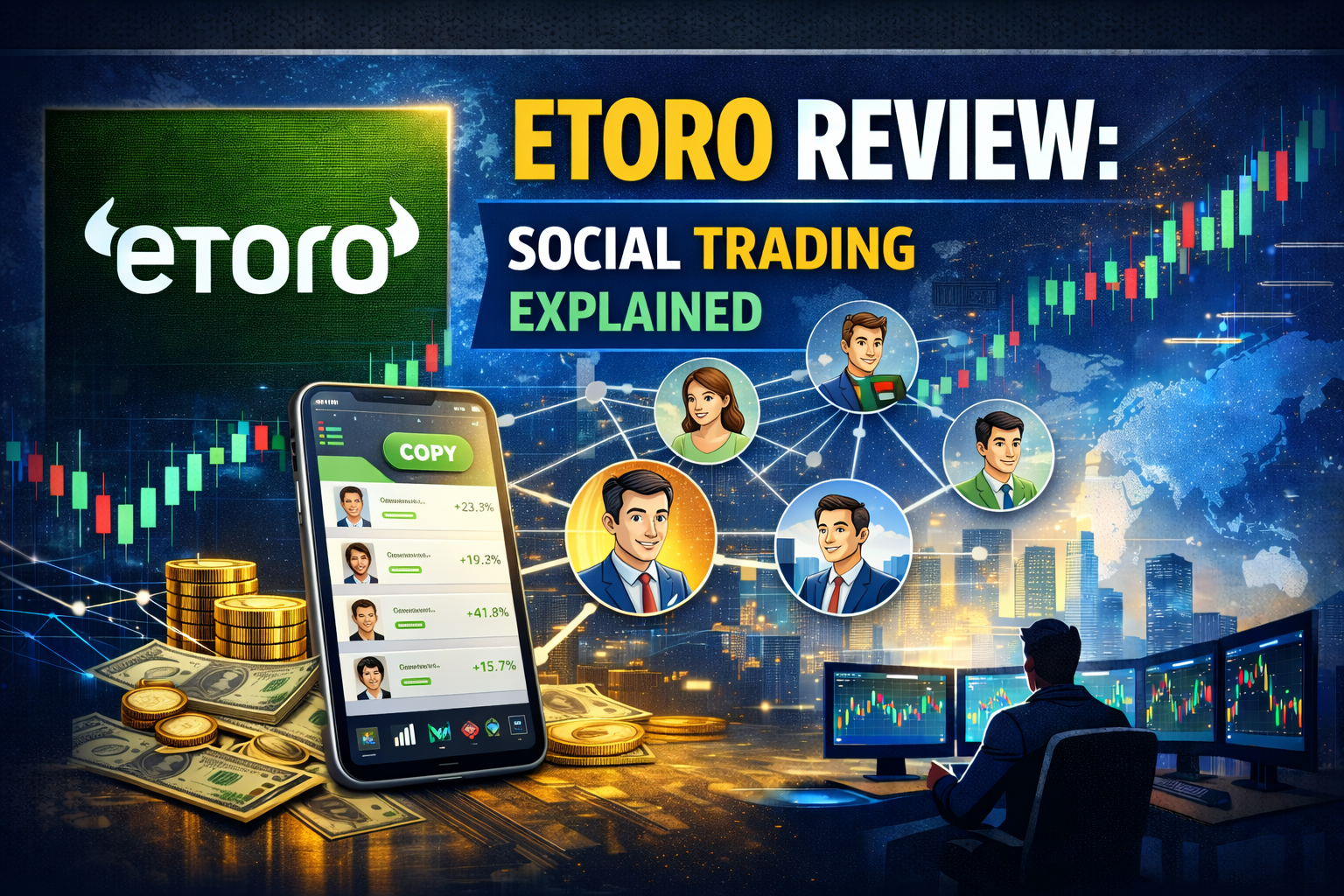
Social trading on eToro can help traders succeed by enabling them to copy experienced investors’ strategies automatically, learn from community insights, and diversify across multiple traders without deep market expertise. However, success isn’t guaranteed—copied traders can lose money, past performance doesn’t predict future results, and beginners still need basic risk management understanding. eToro’s social features reduce learning curves but don’t eliminate trading risks.
Introduction
eToro stands out in the crowded online brokerage landscape through its pioneering social trading features that transform solitary investing into a collaborative community experience. Founded in 2007, the platform now serves over 30 million registered users across 140 countries, offering access to stocks, cryptocurrencies, ETFs, commodities, currencies, and indices through an interface that emphasizes social interaction as much as chart analysis.

Social trading represents eToro’s defining characteristic—the ability to follow, interact with, and automatically copy the trades of successful investors on the platform. This approach democratizes access to trading strategies that traditionally required years of experience or expensive advisory services, allowing newcomers to potentially benefit from seasoned traders’ expertise while learning market dynamics through observation.
This comprehensive review examines how eToro’s social trading ecosystem functions, evaluates the CopyTrader and CopyPortfolios features that enable strategy replication, and provides honest assessment of benefits and limitations. We’ll analyze safety measures, fee structures, and the realistic scenarios where social trading delivers genuine value versus situations where it creates false security.

What Is eToro?
eToro launched in Tel Aviv in 2007 with a vision of opening financial markets to everyone through innovative technology and social features. The company expanded globally over the following decade, obtaining regulatory licenses in multiple jurisdictions including the UK’s Financial Conduct Authority (FCA), Cyprus Securities and Exchange Commission (CySEC), Australian Securities and Investments Commission (ASIC), and the Financial Crimes Enforcement Network (FinCEN) in the United States.
The platform’s multi-asset approach provides exposure to diverse investment categories through a single account. Stock trading covers thousands of individual equities from major exchanges including NYSE, NASDAQ, London Stock Exchange, and other global markets. Cryptocurrency trading encompasses Bitcoin, Ethereum, Ripple, and dozens of other digital assets with 24/7 market access. ETF selection includes broad market index funds, sector-specific funds, and thematic investment vehicles. Forex trading spans major, minor, and exotic currency pairs. Commodities coverage includes gold, silver, oil, natural gas, and agricultural products. Stock indices enable speculation on overall market movements across different countries and sectors.
eToro operates through web-based platforms accessible via standard browsers and dedicated mobile applications for iOS and Android devices. The interface design prioritizes visual clarity and social interaction over the dense technical indicators characteristic of professional trading platforms like MetaTrader. This simplified approach intentionally targets retail investors and beginners rather than institutional traders or quantitative analysts.
Regional availability varies based on local regulations. US clients face significant restrictions, accessing only cryptocurrency trading rather than the full asset range available to international users. This limitation stems from SEC regulations and state-by-state securities laws that constrain eToro’s US operations. European, UK, and Australian clients enjoy comprehensive platform access with strong regulatory protections.

What Is Social Trading?
Social trading fundamentally changes the traditional isolated trading experience by creating networked communities where participants share strategies, insights, and actual trade executions. Instead of relying solely on personal analysis or expensive advisory services, traders access a marketplace of strategies implemented by real investors risking their own capital.
The concept mirrors social media dynamics applied to financial markets. Just as Facebook users follow friends and influencers, social traders follow investors whose approaches, risk profiles, and performance histories align with their goals. Transparency distinguishes social trading from traditional money management—followers see complete track records including losses, drawdowns, and trading frequency rather than cherry-picked highlights.
Traditional trading demands developing personal expertise through years of study, practice, and inevitable losses during the learning process. Traders must master technical analysis, fundamental research, risk management, and emotional discipline independently. Social trading shortcuts portions of this learning curve by enabling strategy access before developing equivalent personal skills, though understanding copied strategies remains advisable for long-term success.
Copy trading represents social trading’s most direct application—automatically replicating another trader’s positions proportionally in your own account. When the copied trader buys Apple stock with 5% of their portfolio, your account simultaneously purchases Apple with 5% of your allocated copy trading capital. This automation continues until you stop copying, creating a hands-off investment approach requiring minimal ongoing involvement.

Peer-to-peer interactions extend beyond automated copying through social feeds, comment sections, and direct messaging. Traders post market analyses, share chart screenshots, discuss trade rationales, and debate economic developments. This community aspect provides educational value and diverse perspectives that isolated traders miss, though separating signal from noise requires critical thinking.
The appeal centers on accessibility and democratization. Someone with $500 and minimal market knowledge can allocate capital across multiple proven traders, gaining market exposure and learning simultaneously. This lowers psychological and educational barriers that prevent many people from participating in financial markets, though it doesn’t eliminate the fundamental risks inherent in market exposure.
How Social Trading Works on eToro
CopyTrader Explained
CopyTrader serves as eToro’s flagship social trading feature, enabling automatic replication of selected investors’ trades proportionally in your account. The system operates through a straightforward allocation model where you dedicate a portion of your capital—minimum $200 per copied trader—to mirroring their positions.
The selection process begins with exploring eToro’s investor marketplace, which displays thousands of traders with verified track records including performance statistics, risk scores, trading frequency, asset preferences, and historical returns. Filters help narrow options by timeframe (last year, six months, three months), risk level (conservative to high), markets traded, and minimum investment periods.
Each trader profile reveals comprehensive performance data beyond simple returns. Maximum drawdown shows the largest peak-to-trough decline they’ve experienced, indicating potential volatility. Average trade duration reveals whether they’re day traders, swing traders, or long-term investors. Win rate percentages demonstrate prediction accuracy, though high win rates don’t guarantee profitability if losing trades exceed winning ones. Asset allocation charts show how they distribute capital across stocks, crypto, forex, and commodities.
Once you allocate funds to copy a trader, eToro’s system automatically replicates their future positions proportionally. If the copied trader invests 10% of their portfolio in Tesla stock, your allocated capital purchases Tesla at 10% proportion. When they close positions, your proportional shares automatically sell. This synchronization continues until you manually stop copying, maintaining parallel positioning throughout the copying period.
The proportional allocation protects against capital mismatches. A trader managing $100,000 might take $5,000 positions, but someone copying with $2,000 allocated receives proportionally sized $100 positions instead. This scaling ensures smaller accounts can copy larger traders without over-leveraging or requiring equivalent capital.
Risk management settings provide some control over automated copying. Stop-loss parameters let you automatically cease copying if losses reach predetermined thresholds, protecting against catastrophic drawdowns. You can pause copying temporarily without closing positions, maintaining current holdings while preventing new trades from replicating. Copy settings also allow closing all copied positions instantly if you lose confidence in the trader’s approach.
CopyPortfolios
CopyPortfolios represent eToro’s managed portfolio products combining multiple assets or traders under unified investment themes. Unlike CopyTrader’s focus on individual traders, CopyPortfolios bundle diversified strategies created either by eToro’s investment committee or algorithmic models.
Market CopyPortfolios group assets by themes, sectors, or strategies. A technology-focused portfolio might include major tech stocks like Apple, Microsoft, Google, Amazon, and Meta with algorithmic rebalancing maintaining target allocations. Cryptocurrency portfolios bundle multiple digital assets with weightings based on market capitalization or other criteria. Thematic portfolios capture trends like renewable energy, artificial intelligence, or genomics by selecting relevant companies and instruments.
Top Trader CopyPortfolios bundle multiple successful eToro traders rather than individual assets. These portfolios combine several traders whose strategies complement each other—perhaps mixing conservative dividend investors with growth-focused traders and opportunistic swing traders. This meta-diversification spreads risk across multiple human decision-makers rather than single traders or asset classes.
Partner CopyPortfolios feature strategies developed by eToro’s partners and investment firms, offering professionally managed approaches previously accessible only through expensive hedge funds or advisory services. These carry higher minimum investments, typically $5,000 or more, reflecting their institutional origins.
The minimum investment for most CopyPortfolios sits at $5,000, significantly higher than CopyTrader’s $200 minimum. This threshold reflects the diversification inherent in bundled approaches—lower minimums would result in fractional positions too small to replicate portfolio strategies effectively.
Algorithmic rebalancing distinguishes CopyPortfolios from static portfolios. The system automatically adjusts holdings to maintain target allocations as market prices fluctuate, buying assets that decline below target weights and selling those exceeding targets. This disciplined rebalancing enforces buy-low-sell-high behavior without emotional interference.
Social Feed & Community Features
eToro’s social feed resembles Facebook or Twitter applied to financial markets, creating an information stream where traders post insights, analyses, trade announcements, and market commentary. Following traders populates your feed with their posts, creating a personalized information flow tailored to your interests and followed investors.
Traders share diverse content types through the feed. Chart screenshots with technical analysis annotations explain entry points, support levels, and pattern interpretations. Text posts discuss macroeconomic developments, earnings reports, or policy changes impacting specific assets. Trade notifications announce position openings and closings with brief rationales. Links to external articles or research reports add depth to discussions.
Community interaction occurs through comments, likes, and direct responses creating threaded discussions beneath posts. Popular posts accumulate extensive comment threads where community members debate analyses, share alternative viewpoints, and ask clarifying questions. This engagement transforms passive information consumption into active learning through dialogue.
The Popular Investor program incentivizes successful traders to share insights and maintain transparent track records by offering payments based on assets under management from copiers. Traders achieving specific performance thresholds and attracting copier capital receive monthly payments scaling with total copied assets, creating financial motivation for maintaining profitability and community engagement.
Newsfeed filtering helps manage information overload by organizing content by asset class, trader tier, or content type. You can focus feeds on specific markets like cryptocurrencies or stocks, filter for posts from only top-tier Popular Investors, or view exclusively trade notifications without commentary.
The community aspect provides genuine educational value beyond automated copying. Reading experienced traders’ reasoning behind position entries reveals thought processes and analytical frameworks that beginners can internalize. Observing how traders respond to adverse price movements or unexpected news develops perspective on adaptive strategy management.
However, social feeds require critical evaluation rather than blind acceptance. Survivorship bias means failed traders disappear from feeds while successful ones remain visible, creating distorted impressions of trading ease. Hindsight explanations often make past trades seem more obvious than they were in real-time. Confirmation bias causes traders to promote their successes more prominently than losses.
Benefits of Social Trading on eToro
For Beginners
Social trading dramatically reduces the knowledge barrier preventing newcomers from participating in financial markets. Someone completely unfamiliar with technical analysis, fundamental research, or market mechanics can allocate capital to proven traders and gain market exposure immediately. This democratization enables learning while invested rather than requiring years of study before risking capital.
Psychological barriers diminish when following established traders rather than making independent decisions. The anxiety of “am I doing this right?” lessens when copying someone with verified multi-year track records and thousands of followers. This confidence reduction doesn’t eliminate risk but removes paralysis that keeps many people permanently on the sidelines.
Educational acceleration occurs through observation and osmosis. Watching copied traders’ position management—when they add to winners, cut losses, or take profits—demonstrates practical risk management beyond theoretical concepts. Reading their social feed explanations connects specific trades to broader market contexts, building mental frameworks for understanding price movements.
The community aspect provides support and perspective that isolated beginners lack. Seeing other traders discuss losses, drawdowns, and mistakes normalizes the inevitable setbacks that discourage solitary traders into abandoning efforts. Community encouragement during difficult periods helps maintain commitment through learning curves.
Demo account availability lets complete beginners practice copying traders with virtual money before risking actual capital. The $100,000 virtual portfolio enables experimenting with different trader combinations, understanding how copying mechanics work, and experiencing virtual gains and losses without financial consequences.
For Intermediate/Advanced Traders
Diversification extends beyond asset classes to include strategy diversification through copying multiple traders with different approaches. Combining trend-following traders, mean-reversion specialists, and fundamental value investors creates a portfolio less dependent on any single market condition favoring specific strategies. When trend-following suffers during choppy markets, mean-reversion strategies might prosper, smoothing overall portfolio volatility.
Time efficiency allows advanced traders to maintain market exposure across assets or strategies they understand theoretically but lack time to monitor actively. Someone employed full-time might copy cryptocurrency traders handling 24/7 market surveillance while personally managing longer-term stock positions requiring less attention.
Strategy insights emerge from studying successful traders’ approaches, potentially revealing techniques or perspectives you hadn’t considered. A primarily technical trader might discover fundamental factors they’d overlooked by following value investors. Someone focused on US markets gains international exposure and perspectives through traders specializing in European or Asian markets.
The Popular Investor program creates income opportunities for consistently profitable traders willing to share strategies transparently. Building copier capital generates monthly payments supplementing trading profits, potentially transforming profitable personal trading into a scalable business model. This monetization rewards both trading skill and community engagement.
Portfolio testing becomes possible by copying traders in small allocations before committing significant capital. Instead of backtesting strategies on historical data with all the limitations that entails, you can allocate $200-500 to copy a trader for several months, observing real-time performance and decision-making before scaling investments.
Risks & Limitations
Copying doesn’t guarantee profits despite successful trader track records. Past performance represents historical results under specific market conditions that may not repeat. A trader excelling during 2020-2023’s generally rising markets might struggle during prolonged downturns or sideways consolidations. Copied positions lose money exactly as independent positions do when markets move unfavorably.
Past performance particularly fails to predict future results when examining short timeframes. A trader showing 50% annual returns over six months might be experiencing temporary luck or benefiting from specific market conditions favoring their approach. Longer track records—three years or more—provide more reliable evidence of sustainable edge, though even these don’t guarantee continued success.
Over-leveraging risks multiply when copying traders who themselves use high leverage. eToro allows leverage up to 1:30 for retail clients on certain instruments. A copied trader using maximum leverage creates equivalent exposure in your account, meaning small adverse movements cause disproportionate losses. Beginners often underestimate how quickly leveraged positions can erase capital during volatile periods.
Emotional risks emerge from misplaced trust in copied traders. When experiencing losses, beginners might blame copied traders rather than accepting market risk inherent in all trading. This blame can manifest as impulsive decisions—stopping copies during temporary drawdowns, switching to different traders repeatedly, or abandoning social trading entirely after isolated negative experiences. Successful copying requires maintaining discipline through inevitable losing periods.
Synchronized risk concentration occurs when multiple copied traders hold similar positions. During major market events, seemingly diverse traders might all suffer simultaneously if they share common exposures. Copying five cryptocurrency traders provides less diversification than it appears if they all hold Bitcoin, Ethereum, and similar assets. This correlation risk defeats diversification purposes.
Fee impacts accumulate across multiple layers. Spreads apply to both your copied positions and the original trader’s positions. Overnight financing charges accrue on leveraged positions. Currency conversion fees hit when trading assets denominated differently from your account currency. Withdrawal fees apply when accessing profits. These compounding costs erode returns more than single-layer fee structures.
Delayed execution creates tracking errors between copied trader positions and your replicated positions. Market prices move between when traders execute and when copy systems replicate trades, potentially creating worse entry prices during fast-moving markets. This slippage means your proportional positions might underperform the original trader’s results even when copying perfectly.
Platform dependency creates risks if eToro experiences technical issues, regulatory problems, or business difficulties. Concentrating all capital on a single platform increases exposure to platform-specific risks versus spreading across multiple brokers. While eToro maintains strong regulatory standing, platform concentration remains a consideration for substantial portfolios.
CRITICAL WARNING: Social trading and copy trading do not eliminate market risk. The majority of retail traders lose money regardless of whether they trade independently or copy others. You can lose all capital invested in copied positions. Never invest money you cannot afford to lose, and maintain emergency funds separate from trading capital.
eToro Pros & Cons
Pros
Industry-leading social features differentiate eToro from traditional brokers by creating genuine community interaction rather than token social elements. The social feed, trader profiles, and community engagement feel authentic rather than superficial marketing additions.
CopyTrader accessibility with $200 minimums enables testing social trading without substantial capital commitment. This low barrier lets beginners experiment with copying multiple traders to find compatible approaches before scaling investments.
Comprehensive asset coverage spanning stocks, crypto, ETFs, forex, commodities, and indices through a single platform eliminates maintaining multiple brokerage accounts. This consolidation simplifies portfolio management and reduces administrative complexity.
Regulated operations across multiple tier-one jurisdictions including FCA, CySEC, and ASIC provide investor protections, compensation schemes, and regulatory oversight that offshore brokers lack. European clients particularly benefit from MiFID II protections and Financial Services Compensation Scheme coverage.
User-friendly interface removes intimidation factors that complex professional platforms create for beginners. The visual design, simplified navigation, and guided workflows make initial platform adoption straightforward compared to MetaTrader’s steep learning curves.
Demo account with $100,000 virtual capital enables extensive risk-free practice including copying traders, testing CopyPortfolios, and experiencing platform mechanics before financial commitment. Unlimited demo access without expiration dates supports long-term learning.
Fractional share purchases allow investing in high-priced stocks like Amazon or Google with minimal capital, enabling diversified stock portfolios that traditional share purchasing would make prohibitively expensive for small accounts.
Popular Investor transparency ensures copied traders risk their own capital alongside copiers rather than simply providing signals without personal exposure. This alignment of interests distinguishes eToro from signal services where providers face no consequences from bad recommendations.
Cons
Limited advanced tools frustrate experienced traders accustomed to professional platforms’ extensive technical indicators, drawing tools, and customization options. The simplified interface that helps beginners simultaneously constrains advanced analysis capabilities.
Higher fees on certain instruments compared to specialized brokers, particularly for active forex and CFD traders. While stock and ETF fees remain competitive, spread-dependent instruments often cost more than ultra-low-cost brokers like Interactive Brokers or specialized forex platforms.
Withdrawal fees of $5 per transaction add friction to accessing profits, particularly impacting small accounts where $5 represents significant percentage costs. This flat fee structure penalizes smaller withdrawals disproportionately.
US availability restrictions severely limit American investors to cryptocurrency-only trading, excluding stocks, ETFs, and most instruments available internationally. This regulatory limitation makes eToro less relevant for US-based users.
Weekend trading unavailability for most instruments means positions held Friday through Monday accumulate three days of overnight fees despite markets being closed. This triple-charge weekend treatment increases holding costs for swing traders.
Mandatory stop-loss requirements on some CFD positions constrain strategy flexibility for traders preferring to manage risk through other methods like position sizing or hedging. The platform’s risk management rules sometimes conflict with advanced trading approaches.
Limited short-selling options compared to professional brokers, with short positions available only through CFDs rather than traditional margin accounts. This limits strategies for bearish market views or hedge implementations.
Cryptocurrency ownership limitations—eToro crypto positions represent CFDs rather than actual cryptocurrency ownership unless purchasing specific amounts meeting platform criteria. This prevents withdrawing crypto to external wallets for most positions, reducing utility for those seeking actual digital asset ownership.
| Feature | Pros | Cons |
|---|---|---|
| Social Features | Industry-leading community, transparent trader profiles | Can create false confidence, social pressure influences |
| CopyTrader | Low $200 minimum, automatic replication | Doesn’t guarantee profits, tracking errors possible |
| Asset Coverage | Stocks, crypto, ETFs, forex, commodities in one platform | Limited compared to specialized brokers in each category |
| Regulation | FCA, CySEC, ASIC oversight | US restrictions, varying protection by jurisdiction |
| Fees | Competitive stock/ETF fees, zero commissions on stocks | Higher forex/CFD spreads, $5 withdrawal fee |
| Platform | Beginner-friendly, mobile-optimized | Lacks advanced tools, limited customization |
Is eToro Safe & Legit?
eToro operates as a fully legitimate, regulated brokerage rather than a scam or fraudulent operation. The company holds licenses from multiple tier-one financial regulators including the UK’s Financial Conduct Authority (FCA), Cyprus Securities and Exchange Commission (CySEC), and Australian Securities and Investments Commission (ASIC). These regulatory bodies impose strict capital requirements, operational standards, and investor protection rules that eToro must maintain to preserve licensing.
European clients benefit from MiFID II investor protections including negative balance protection preventing losses exceeding account deposits, mandatory best execution policies, and access to the Financial Services Compensation Scheme covering up to £85,000 per person if eToro fails financially. These regulatory safeguards provide meaningful safety nets that offshore brokers lack.
Fund segregation separates client deposits from eToro’s operational capital, preventing the company from using customer funds for business expenses or investments. Client money resides in segregated accounts at tier-one banks, protected from creditors if eToro faces bankruptcy. This segregation represents a fundamental safety requirement imposed by major regulators.
SSL encryption protects data transmission between users and eToro’s servers, preventing interception of login credentials, personal information, and trading instructions. Two-factor authentication adds secondary verification beyond passwords, requiring access to registered mobile devices for account access.
eToro’s long operational history since 2007 demonstrates business sustainability through multiple market cycles including the 2008 financial crisis, European debt crisis, and COVID-19 pandemic volatility. This longevity provides evidence of viable business models and competent management, distinguishing established brokers from new entrants lacking proven track records.
However, safety levels vary by jurisdiction and client classification. Professional clients waive certain retail protections in exchange for higher leverage limits, accepting increased risk exposure. Clients in jurisdictions where eToro operates through less-regulated entities receive fewer protections than European counterparts. Understanding which eToro entity holds your specific account determines applicable protections.
The platform cannot eliminate market risk—investments lose value when markets decline regardless of broker safety. eToro’s legitimacy ensures your capital isn’t stolen, but provides no protection against losses from poor trading decisions, whether independent or through copying unsuccessful traders.
Reputation indicators including millions of active users, institutional partnerships, and mainstream media coverage support legitimacy claims. The company’s publicly disclosed funding rounds and valuations indicate serious institutional investment backing, further validating operational legitimacy.
Who Is eToro Best For?
Complete beginners seeking market exposure without extensive education find eToro particularly well-suited. The social trading features enable investment participation while learning, and the simplified interface removes technical barriers that professional platforms create. Someone with basic financial literacy can start copying traders within hours of account creation.
Casual investors preferring passive approaches over active trading benefit from CopyTrader’s automation. Setting copy allocations requires minimal ongoing time once initial trader selections complete, making eToro appropriate for those wanting market exposure without constant monitoring or decision-making.
Part-time traders balancing full-time employment with trading interests use eToro to maintain market engagement despite time constraints. Copying traders handles execution while holding regular jobs, supplemented by personal trades during available evening or weekend hours.
Social learners who absorb information better through community interaction and observation rather than solitary study find eToro’s educational model more effective than traditional courses or books. The combination of copying, feed reading, and community discussions creates immersive learning environments.
Small-account traders appreciate low minimums enabling diversification across multiple copied traders or CopyPortfolios despite limited capital. Someone with $1,000 can copy five different traders at $200 each, creating strategy diversification impossible with higher-minimum investment vehicles.
Cryptocurrency enthusiasts gain convenient multi-crypto exposure through a regulated platform with simpler onboarding than dedicated crypto exchanges. The social features also provide community insights into volatile crypto markets where information edges matter significantly.
eToro works less well for:
Professional traders requiring advanced technical analysis tools, algorithmic trading capabilities, or extensive customization find the platform’s simplified approach constraining. Professionals typically prefer MetaTrader, cTrader, or institutional platforms offering sophisticated features eToro lacks.
High-frequency traders face unsuitable execution speeds and fee structures for strategies requiring dozens or hundreds of daily trades. The social platform architecture optimizes for longer-term approaches rather than scalping or arbitrage.
US investors seeking comprehensive asset access find severe limitations with crypto-only availability. Americans wanting stock and ETF trading should consider Interactive Brokers, TD Ameritrade, or other fully-licensed US brokers.
Privacy-focused traders preferring anonymity dislike the inherently public nature of social trading where positions, returns, and strategies become visible to the community if becoming a copied trader. While following others maintains privacy, participating fully as a copied trader requires transparency.
FAQ
What makes eToro different from other brokers?
eToro’s distinguishing feature is comprehensive social trading integration rather than token social elements. CopyTrader enables automatic replication of successful investors’ trades, while social feeds create community interaction around market analysis and strategy discussions. Most traditional brokers offer purely transactional platforms without social features, making eToro unique in combining trading execution with social networking dynamics. The Popular Investor program also differentiates by compensating successful traders for transparency and copier assets.
How does social trading on eToro work?
Social trading on eToro operates through two primary mechanisms: CopyTrader and CopyPortfolios. CopyTrader lets you allocate capital (minimum $200) to automatically replicate individual traders’ positions proportionally—when they buy 10% Tesla, your allocated capital purchases 10% Tesla. CopyPortfolios bundle multiple assets or traders under unified themes with algorithmic rebalancing. The social feed provides community interaction where traders share analyses, discuss markets, and explain their reasoning, creating learning opportunities beyond automated copying.
Can beginners benefit from CopyTrader?
Beginners can benefit from CopyTrader by gaining market exposure and learning simultaneously without developing equivalent personal expertise first. However, benefits require selecting suitable traders based on risk tolerance, understanding that copied positions lose money when markets move adversely, and maintaining realistic expectations about returns. Beginners must avoid over-allocating to high-risk traders, diversify across multiple copied investors, and use demo accounts initially. CopyTrader reduces learning curves but doesn’t eliminate market risk or guarantee profits.
Are there fees for social trading on eToro?
eToro charges no specific fees for using CopyTrader or accessing social features, but standard trading fees apply to all positions including copied ones. Spreads—the difference between buy and sell prices—represent the primary cost, varying by asset class. Overnight financing fees accrue on leveraged positions held beyond trading days. Currency conversion fees apply when trading assets denominated differently from your account currency. A flat $5 withdrawal fee applies when accessing capital. These costs affect copied positions identically to independent trades.
Is social trading safe on eToro?
Social trading on eToro is safe from platform legitimacy and security perspectives—eToro operates under tier-one regulation with proper fund segregation and data protection. However, “safe” doesn’t mean profitable or risk-free. Copied traders can and do lose money, sometimes substantially during market downturns. Past performance doesn’t guarantee future results, and even successful traders experience drawdowns. Safety requires proper risk management including diversification across multiple traders, avoiding over-leverage, and never investing capital you cannot afford to lose. The platform is legitimate, but market risk remains inherent.
Conclusion
Social trading on eToro delivers genuine value for specific user profiles while presenting legitimate limitations that prevent universal suitability. The platform successfully democratizes access to trading strategies and market participation through innovative features that distinguish it from traditional brokerages.
For beginners and casual investors, eToro represents one of the most accessible entry points into financial markets. CopyTrader’s automation, low minimums, and community learning resources lower barriers that prevent many people from investing. The ability to allocate $200 and immediately gain exposure to proven traders’ strategies provides practical value that purely educational approaches lack. However, accessibility doesn’t eliminate market risk—beginners must maintain realistic expectations and understand that copied traders experience losses alongside gains.
Key advantages—comprehensive social features, regulated operations across major jurisdictions, user-friendly interface, multi-asset coverage, and transparent trader performance data—create a compelling proposition for those seeking community-integrated investing. The Popular Investor program aligns incentives between copied traders and copiers since traders risk their own capital alongside follower allocations.
Significant limitations—higher fees compared to ultra-low-cost brokers, limited advanced tools, US availability restrictions, and the inherent risk that past performance doesn’t guarantee future results—prevent eToro from serving all trader types effectively. Professionals and high-frequency traders should seek specialized platforms offering capabilities eToro lacks.
Final verdict: eToro excels as a beginner-friendly social investing platform that makes strategy diversification accessible through copying rather than requiring extensive personal expertise. Success requires selecting compatible traders based on genuine performance analysis rather than recent returns, maintaining diversification across multiple strategies, and accepting that all trading carries substantial loss risk regardless of copying mechanisms.
Rating: ★★★★☆ (4/5) — eToro earns strong marks for innovation, accessibility, and regulatory compliance, with one star deducted for higher fees on certain instruments and limited advanced capabilities. The platform deserves consideration from beginners and casual investors seeking community-integrated market access, while experienced traders should evaluate whether social features justify the tradeoffs versus specialized alternatives.
Recommendation: Start with eToro’s demo account to practice copying traders and understanding platform mechanics without financial risk. When transitioning to live trading, begin with minimum allocations ($200 per trader) across 3-5 different traders with varying strategies. Monitor copied positions actively rather than treating social trading as completely passive investing. View eToro as a learning platform and diversification tool rather than a guaranteed profit mechanism, maintaining appropriate risk management regardless of copied traders’ historical success.