


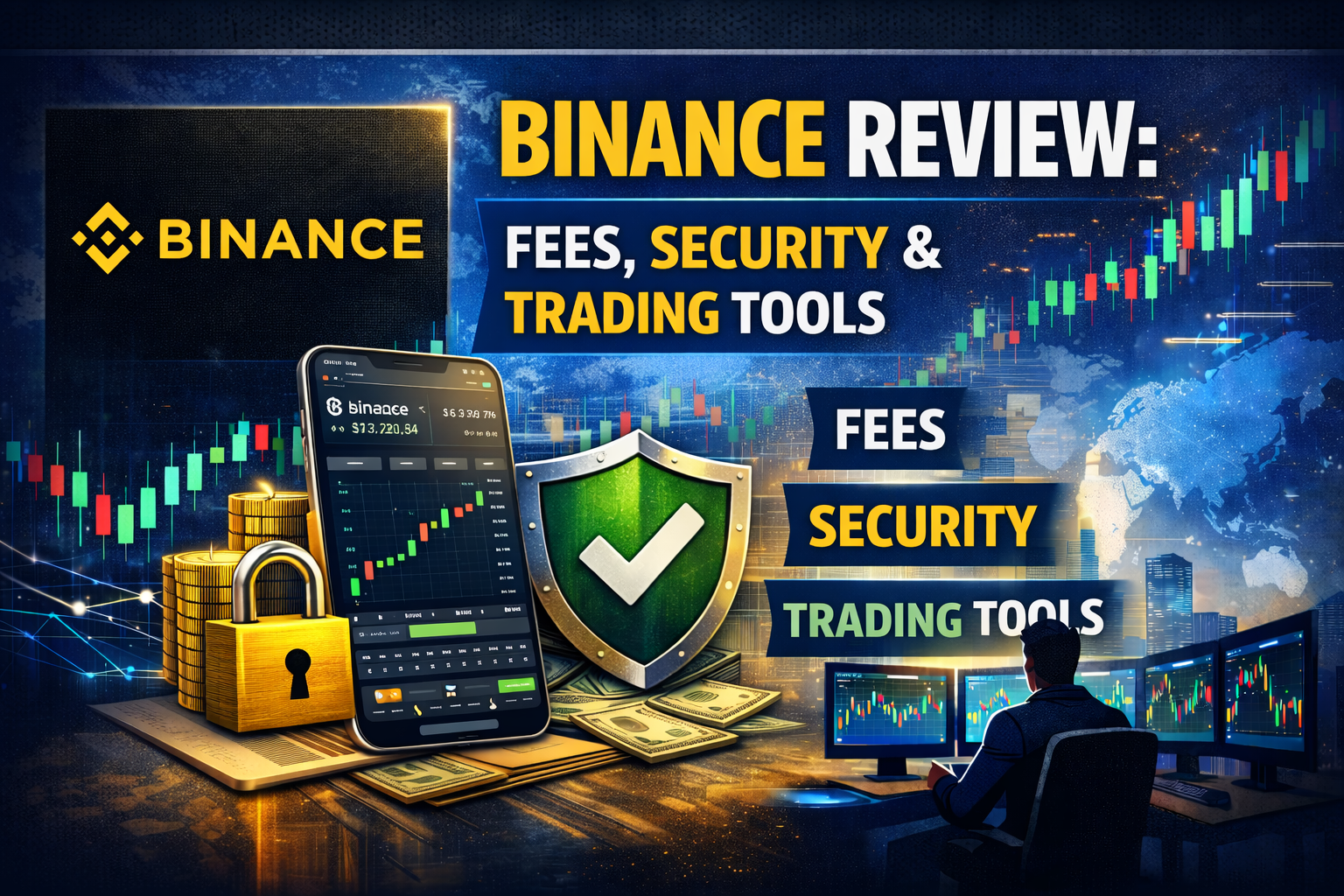
Binance is one of the world’s largest cryptocurrency exchanges by trading volume, serving millions of users across over 100 countries. Founded in 2017, the platform has grown rapidly to become a comprehensive crypto ecosystem offering spot trading, futures, staking, and peer-to-peer services.
This review examines Binance’s fee structure, security infrastructure, and trading capabilities to help you determine if it aligns with your crypto investment needs. The short answer: Binance offers competitive low fees, robust security measures, and professional-grade trading tools, though its complexity may challenge newcomers.
We’ll break down exactly what you’re paying, how your funds are protected, and which features matter most for different trader types.
What Is Binance?
Binance began as a cryptocurrency exchange platform and has evolved into a full financial ecosystem for digital assets. The company was established by Changpeng Zhao in 2017 and quickly captured significant market share through low trading fees and extensive coin listings.

Today, Binance supports trading for over 350 cryptocurrencies and tokens. The platform serves more than 150 million registered users worldwide, processing billions of dollars in daily trading volume across multiple product categories.
Beyond basic spot trading, Binance provides futures contracts, margin trading, peer-to-peer exchanges, staking services, savings products, and NFT marketplaces. Users can access these features through web browsers, desktop applications, or mobile apps for iOS and Android.
Regional availability varies significantly due to regulatory requirements. The platform operates globally but faces restrictions in certain jurisdictions including the United States, where Binance.US serves as a separate entity with limited features. Users should verify their region’s specific regulations and available services before registering.
Binance Fees Explained
Trading Fees
Binance uses a tiered fee structure based on your 30-day trading volume and BNB holdings. The standard spot trading fees start at 0.1% for both makers and takers, which ranks among the lowest in the cryptocurrency exchange industry.
For futures trading, fees begin at 0.02% for makers and 0.04% for takers. Margin trading follows the same fee schedule as spot trading at 0.1% per transaction.
When you pay fees using Binance Coin (BNB), you receive a 25% discount on all trading fees. This reduces standard spot fees to 0.075% and can provide substantial savings for active traders. Higher trading volumes unlock additional fee reductions, with VIP tiers offering rates as low as 0.02% for spot trading.
Deposit & Withdrawal Fees
Cryptocurrency deposits to Binance are free regardless of the digital asset. The platform absorbs these network costs to encourage users to fund their accounts.
Withdrawal fees vary by cryptocurrency and reflect the current network conditions for each blockchain. Bitcoin withdrawals typically cost between 0.0002 to 0.0005 BTC, while Ethereum withdrawals range from 0.003 to 0.006 ETH depending on network congestion. These fees are not set by Binance but represent the actual cost of processing transactions on respective blockchains.

Fiat currency deposits and withdrawals depend on your payment method and location. Bank transfers are often free or carry minimal fees, while credit card deposits may incur charges of 3% to 4%. Some regions support SEPA transfers, ACH payments, or local payment methods with varying fee structures.
Hidden or Additional Costs
Binance uses a spread-based pricing model for instant buy/sell conversions, which can result in slightly less favorable rates compared to limit orders on the spot market. This convenience fee typically ranges from 0.5% to 2% depending on market conditions.
Futures traders face funding rates, which are periodic payments exchanged between long and short position holders. These rates fluctuate based on market sentiment and can either cost you or earn you money depending on your position and prevailing rates.
Currency conversion fees apply when trading between fiat currencies or when using auto-conversion features. These are generally around 1% but can vary.
Fee Comparison Table
| Fee Type | Standard Rate | With BNB Discount |
|---|---|---|
| Spot Trading (Maker/Taker) | 0.1% / 0.1% | 0.075% / 0.075% |
| Futures Trading (Maker/Taker) | 0.02% / 0.04% | 0.015% / 0.03% |
| Crypto Deposits | Free | Free |
| Crypto Withdrawals | Varies by coin | Varies by coin |
| Credit Card Deposits | 3-4% | 3-4% |
Binance Security & Safety
Security Measures
Binance implements multi-layered security protocols to protect user accounts and funds. Two-factor authentication is mandatory for all accounts, requiring users to verify login attempts and withdrawals through authenticator apps or SMS codes.
The platform stores the majority of user funds in cold wallets, which are offline storage solutions disconnected from the internet. This approach protects assets from online hacking attempts, with only a small percentage of funds kept in hot wallets for daily operations.
Anti-phishing codes allow users to verify that emails genuinely come from Binance rather than scammers. Each user sets a unique code that appears in all official Binance communications.
Device management features let you whitelist trusted devices and receive alerts when new devices access your account. Withdrawal address whitelisting ensures funds can only be sent to pre-approved cryptocurrency addresses, adding another layer of protection against unauthorized transfers.
Fund Protection
The Secure Asset Fund for Users (SAFU) serves as an emergency insurance fund holding 10% of all trading fees collected by Binance. This reserve fund currently holds hundreds of millions of dollars and exists specifically to protect users in extreme circumstances.
In 2019, Binance experienced a security breach where hackers stole 7,000 Bitcoin worth approximately $40 million at the time. The platform used SAFU funds to reimburse all affected users fully, and no user lost money in the incident. Binance transparently communicated throughout the event and implemented additional security measures afterward.
The platform also maintains a bug bounty program, rewarding security researchers who identify and report vulnerabilities before they can be exploited.
Regulation & Compliance
Binance requires Know Your Customer verification for most account functions. Basic verification requires identity documents and facial recognition, while advanced verification may request proof of address and additional documentation.
Regulatory compliance varies significantly by region. The platform has obtained licenses in France, Italy, Spain, and other European countries while facing restrictions or investigations in jurisdictions including the United Kingdom, Japan, and Singapore at various points.
Users should understand that cryptocurrency investments carry inherent risks including market volatility, regulatory changes, and potential loss of funds. No exchange can guarantee complete protection against all risks, and holding large amounts of cryptocurrency on any exchange involves counterparty risk.
Binance Trading Tools & Features
Spot & Advanced Trading
Binance offers two primary trading interfaces. The basic Lite mode presents a simplified view suitable for beginners, displaying essential buy and sell functions with minimal complexity.
The advanced trading interface provides professional-grade charting powered by TradingView integration. Users access dozens of technical indicators including moving averages, RSI, MACD, Bollinger Bands, and Fibonacci retracements. The platform supports multiple chart types, drawing tools, and customizable layouts.
Order types extend beyond simple market and limit orders to include stop-loss, stop-limit, OCO (one-cancels-the-other), trailing stop, and post-only orders. These advanced options give experienced traders precise control over entry and exit strategies.
Futures, Margin & Derivatives
Binance Futures allows trading with leverage up to 125x on certain cryptocurrency pairs, though such high leverage carries extreme risk and can lead to rapid liquidation. The platform offers both perpetual contracts (no expiry) and quarterly futures (with settlement dates).
Margin trading enables borrowing funds to increase position sizes, with isolated margin (risk limited to specific positions) and cross margin (collateral shared across all positions) options available.
Important Warning: Leverage amplifies both gains and losses. Most retail traders lose money when trading with leverage, and positions can be liquidated automatically if the market moves against you. These products suit experienced traders who fully understand the risks.
Additional Tools
Binance Earn consolidates various passive income products including flexible savings (withdraw anytime), locked staking (higher rates, fixed terms), and DeFi staking for participating in blockchain networks.
The peer-to-peer marketplace connects buyers and sellers directly, supporting local payment methods in numerous countries. This feature provides access to cryptocurrency in regions with limited banking integration.
Trading bots and algorithmic strategies are available through Binance’s built-in tools or via API access for custom development. Grid trading, dollar-cost averaging, and rebalancing bots help automate trading strategies.
The Binance mobile app mirrors nearly all desktop functionality, allowing traders to monitor positions, execute trades, and manage portfolios from smartphones with a responsive, well-designed interface.
Pros & Cons of Binance
Pros
- Extremely competitive trading fees starting at 0.1% with additional BNB discounts
- Over 350 cryptocurrencies available for trading across multiple markets
- Professional-grade charting tools and advanced order types
- Deep liquidity pools ensuring efficient trade execution with minimal slippage
- Multiple earning opportunities through staking, savings, and lending products
- Robust security infrastructure with SAFU fund protection
- Comprehensive mobile app with full feature access
Cons
- Complex interface overwhelms beginners despite Lite mode availability
- Regulatory restrictions limit access in certain countries including the United States
- High-leverage products present significant risk for inexperienced traders
- Customer support response times can be slow during high-volume periods
- Frequent product updates and interface changes require ongoing learning
- Limited fiat currency options in some regions
Who Is Binance Best For?
Beginners: Binance serves newcomers to cryptocurrency, though the learning curve is steeper than simpler exchanges like Coinbase. The Lite mode and educational resources (Binance Academy) help, but beginners should start with small amounts and focus on spot trading rather than derivatives. Expect to spend time learning the platform’s extensive features.
Intermediate Traders: The platform excels for users who understand basic crypto trading and want access to more cryptocurrencies, better fees, and additional features like staking. The balance of usability and functionality suits traders ready to expand beyond basic buy-and-hold strategies.
Professional and High-Volume Traders: Binance is purpose-built for active trading with institutional-grade tools, API access, low fees, and deep liquidity. VIP tier benefits provide additional advantages for accounts processing significant volume. Advanced traders will find everything needed for sophisticated strategies.
Long-Term Crypto Investors: Those looking to accumulate and hold cryptocurrency benefit from the wide selection of assets, staking opportunities, and savings products that generate passive income on holdings. However, consider moving large long-term holdings to personal cold wallets for maximum security.
Frequently Asked Questions
Is Binance safe to use?
Binance implements strong security measures including two-factor authentication, cold storage for most funds, and the SAFU emergency insurance fund. While no exchange is completely risk-free, Binance maintains one of the better security records in the industry and has successfully protected users during past incidents.
How low are Binance trading fees?
Standard spot trading fees are 0.1% for both makers and takers, which drops to 0.075% when paying with BNB. These rates rank among the lowest available on major exchanges. High-volume traders can achieve even lower fees through VIP tiers, with rates dropping to 0.02% or less.
Does Binance charge hidden fees?
The platform is transparent about fees, though some costs may not be immediately obvious. Instant buy/sell conversions include spreads of 0.5% to 2%, futures trading involves funding rates, and currency conversions carry approximately 1% fees. All fees are disclosed in the fee schedule, but users should review transaction details carefully.
Are Binance tools suitable for beginners?
The platform offers a simplified Lite mode for beginners, making basic buying and selling accessible. However, the full range of features is complex and can overwhelm new users. Beginners can start with basic functions and gradually explore advanced tools as they gain experience.
Can you trade with leverage on Binance?
Yes, Binance offers margin trading up to 10x leverage and futures trading up to 125x leverage on certain pairs. However, leveraged trading carries substantial risk of rapid losses and account liquidation. These features are intended for experienced traders who understand the risks involved.
Conclusion
Binance stands as a comprehensive cryptocurrency exchange offering some of the industry’s lowest fees, starting at 0.1% for spot trading and reducing further with BNB discounts. The platform’s security infrastructure, backed by the SAFU emergency fund and multi-layered protections, provides reasonable assurance for user funds while acknowledging that all exchanges carry inherent risks.
The trading tools and features rival professional trading platforms, with advanced charting, numerous order types, futures contracts, and extensive cryptocurrency selection. Additional services like staking and savings products create opportunities beyond simple trading.
For active traders, cryptocurrency enthusiasts seeking wide asset selection, and users prioritizing low fees with deep liquidity, Binance delivers substantial value. The complexity that enables these features makes the platform less ideal for absolute beginners, though committed learners can successfully navigate the ecosystem.
Final verdict: Binance is worth using if you’re willing to invest time learning the platform and need access to extensive cryptocurrencies, professional trading tools, or competitive fees. Those seeking simplicity or living in restricted regions should explore alternatives, while experienced traders will find Binance among the most capable platforms available.